| Organic Certification | Valid certification from an authority recognized in the intended sales market; certification scope should cover processing and handling. | “Organic” claims must be supported by documented production and processing controls. | Check the certificate number, validity period, product scope, and certifying-body database where available. |
| Ingredient Composition | 100% organic sweet potato unless other ingredients are clearly declared. | A single-ingredient powder is easier to trace and evaluate for allergens, additives, and authenticity. | Review the ingredient list, allergen statement, processing aids, and product specification. |
| Moisture Content | Typically about 4%–8% for a free-flowing dried powder; the supplier’s specification should state the exact limit. | Excess moisture can cause caking, discoloration, flavor deterioration, and microbial growth. | Request a recent certificate of analysis and confirm the testing method used. |
| Water Activity (aw) | Preferably ≤0.60 for a shelf-stable dry powder, subject to the supplier’s validated specification. | Water activity measures available water and is more useful than moisture alone for estimating microbial growth risk. | Ask for a recent aw result and confirm that the sample was tested in a sealed, representative condition. |
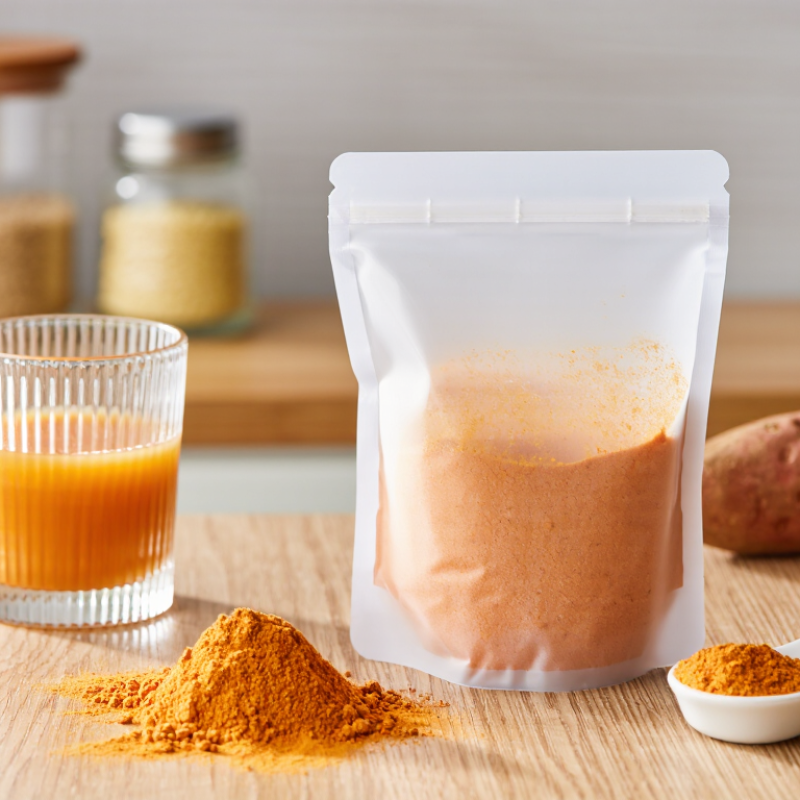
| Color and Appearance | Uniform powder with a natural cream, yellow, orange, or purple tone appropriate to the sweet potato variety; no visible mold, insects, or foreign matter. | Uneven color, darkening, or visible particles may indicate oxidation, overheating, poor storage, or contamination. | Inspect a representative sample under neutral light and compare it with the approved product specification. |
| Aroma and Taste | Clean, characteristic sweet-potato aroma and flavor; no musty, rancid, smoky, chemical, or fermented notes. | Off-odors can signal oxidation, moisture exposure, contamination, or unsuitable processing conditions. | Conduct sensory evaluation using a retained sample and documented acceptance criteria. |
| Particle Size | Common commercial specifications are approximately 60–100 mesh, depending on the application. | Particle size affects dispersibility, mouthfeel, hydration rate, and consistency in bakery, beverage, and supplement applications. | Request the sieve-analysis result and test a sample in the intended recipe. |
| Packaging Material | Food-contact-grade, moisture-barrier packaging, such as a sealed multilayer pouch or lined fiber container. | Dry powders readily absorb moisture and odors from the environment. | Confirm food-contact compliance, barrier specifications, seal integrity, and compatibility with organic handling requirements. |
| Light and Oxygen Protection | Opaque or light-resistant packaging with minimal headspace; oxygen-control measures may be used when validated. | Light and oxygen can accelerate pigment fading, flavor loss, and oxidation. | Check packaging structure, closure system, and whether the supplier has shelf-life validation data. |
| Package Sealing | Continuous, intact heat seal or equivalent closure with no pinholes, leakage, swelling, or powder trapped in the seal. | A defective seal can allow moisture, oxygen, insects, or microorganisms to enter. | Inspect every shipment visually and use documented seal-integrity checks for quality control. |
| Unopened Shelf Life | Often 18–24 months from manufacture when sealed and stored under the stated conditions; the validated date on the package takes priority. | Shelf life depends on moisture, oxygen, light, packaging, processing, and storage temperature. | Check the manufacture date, best-before date, lot code, and supporting stability or shelf-life records. |
| Storage Conditions | Store sealed in a cool, dry, clean, odor-free place, protected from direct sunlight; follow the supplier’s specified temperature and humidity limits. | Heat and humidity shorten shelf life and increase caking and quality deterioration. | Review warehouse records and use first-expire, first-out stock rotation. |
| Microbiological Safety | Each lot should meet applicable legal and customer limits for pathogens, aerobic plate count, yeast, and mold. | Low moisture does not guarantee the absence of pathogens; some microorganisms can survive in dry foods. | Request lot-specific microbiological results and verify the laboratory’s competence and test methods. |
| Heavy Metals and Contaminants | Results should comply with the maximum levels required in the destination market for lead, cadmium, arsenic, pesticides, and other relevant contaminants. | Root crops can be exposed to soil-related contaminants and agricultural residues. | Request risk-based, periodic testing from an accredited laboratory and review the applicable regulations. |
| Traceability | Clear lot or batch code linked to raw-material records, processing date, test results, and distribution history. | Traceability supports efficient recalls and helps identify quality problems quickly. | Perform a mock recall and confirm that one lot can be traced one step back and one step forward. |
| Allergen and Cross-Contact Control | Documented allergen-control program with accurate labeling of shared-facility or cross-contact risks. | Sweet potato is not one of the major allergens in many jurisdictions, but shared equipment can introduce other allergens. | Review the allergen matrix, sanitation procedures, label statement, and verification records. |
| Labeling Compliance | Label should state product name, organic status, net quantity, lot code, date marking, storage instructions, origin where required, and responsible operator details. | Complete labeling supports legal compliance, consumer safety, and product traceability. | Compare the label with the destination market’s food-labeling and organic-claim requirements. |